

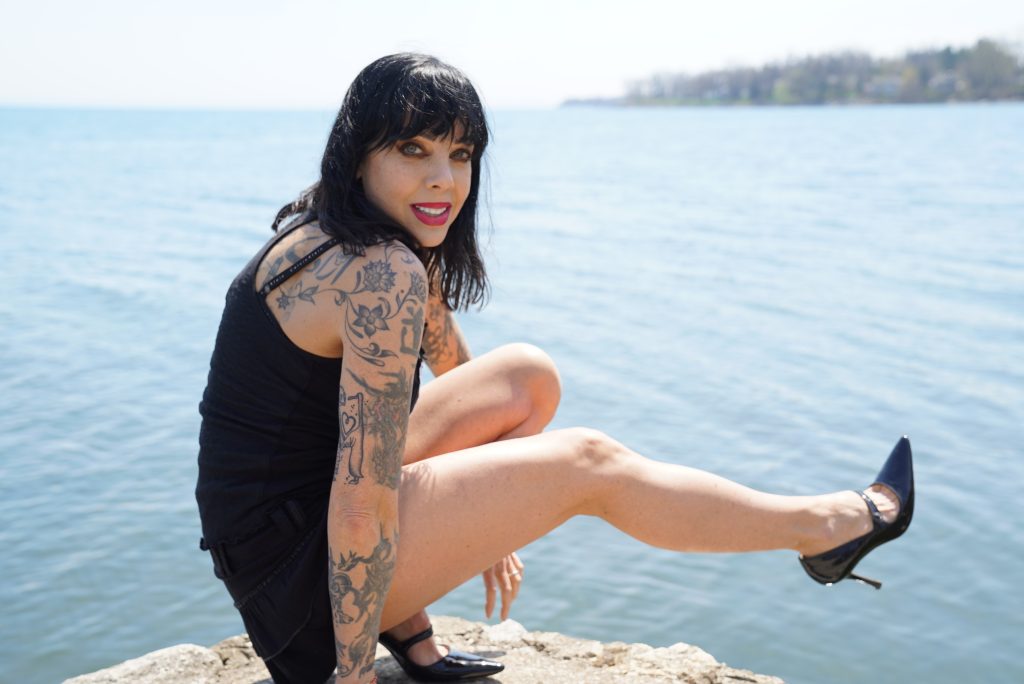
Bif Naked: photo credit: Coco and Kensington
BY KAREN BLISS
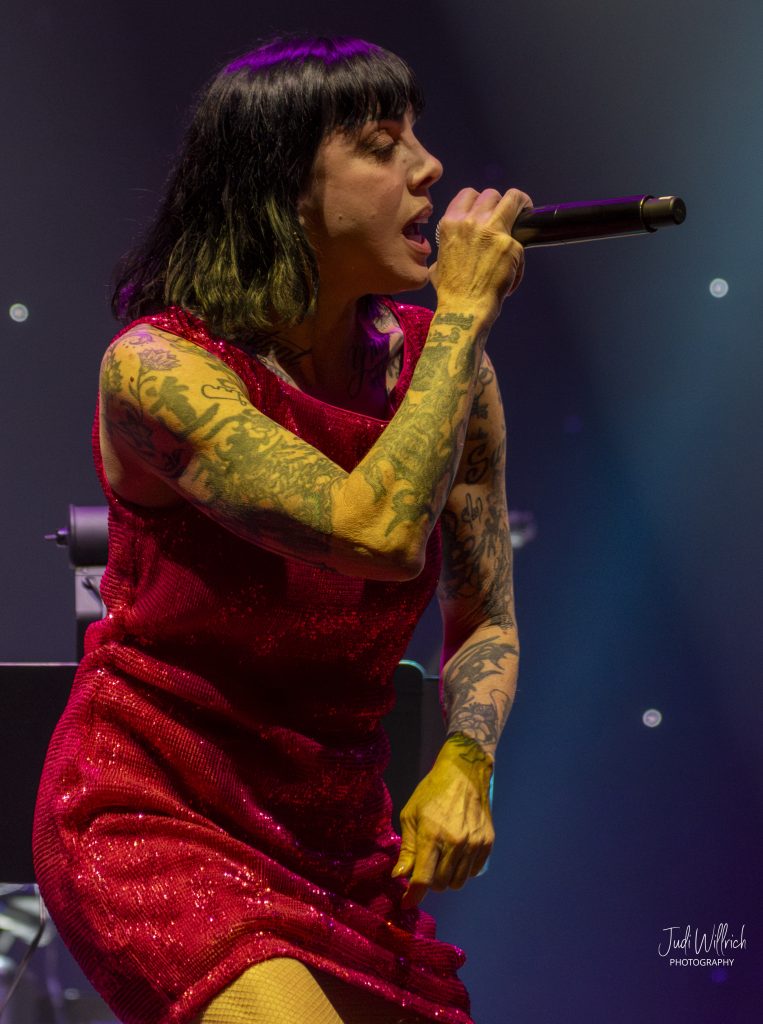
Rock singer-songwriter Bif Naked, the empowering voice behind “I Love Myself Today,” “Spaceman,” “Lucky” and “Daddy’s Getting Married,” and the subject of a new documentary on Super Channel by director Pollyanna Hardwicke-Brown, is a label owner, best-selling author, actress, cancer survivor, motivational speaker, and, in another life, could well have been a standup comedian.
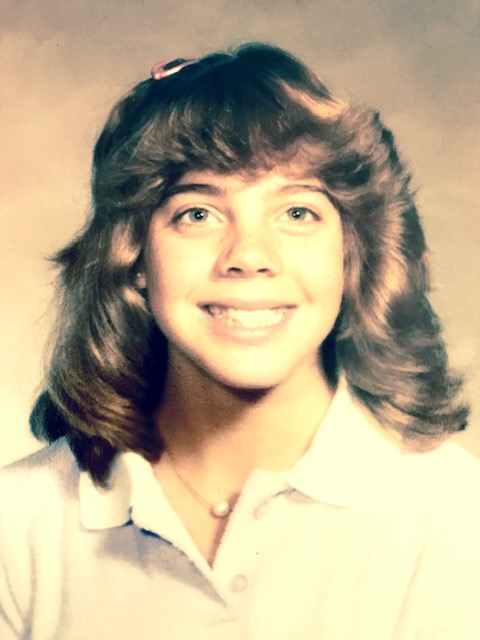
Born in India, adopted by American missionaries, raised in Winnipeg, and now residing in Toronto, she has gone through a lot in her 56 years, things she has put in songs — “Chotee” (abortion) and “Tell On You” (sexual assault) — revealed in her 2016 book, I Bificus: A Memoir, and opened up about in the film. She usually does so with a chuckle or a quip; Bif— whose real name is Beth Torbert — often uses humour to protect her well-being. She is a self-described people-pleaser, against the advice of her manager, Peter Karroll, who has stuck with her — and she him — for 34 years. Photo: Little Bif – Photo Provided
“I wouldn’t be standing without Peter’s belief in me all this time,” she tells Crushing It.
Since starting in music in her teens, fronting punk bands, Bif has always been independent. When she struck out as a solo artist, she created her own label, Her Royal Majesty’s Records (HRMR), with Karroll, and has released six full-length studio albums: her eponymously titled debut in 1994; the platinum-selling breakthrough, I Bificus, in 1996 (re-released in 1998); gold Purge in 2001; emotional Superbeautifulmonster in 2005; The Promise, made during her cancer battle, in 2009; and her long-awaited return, 2024’s Champion, with EPs along the way. “You just can’t ever give up,” she says.
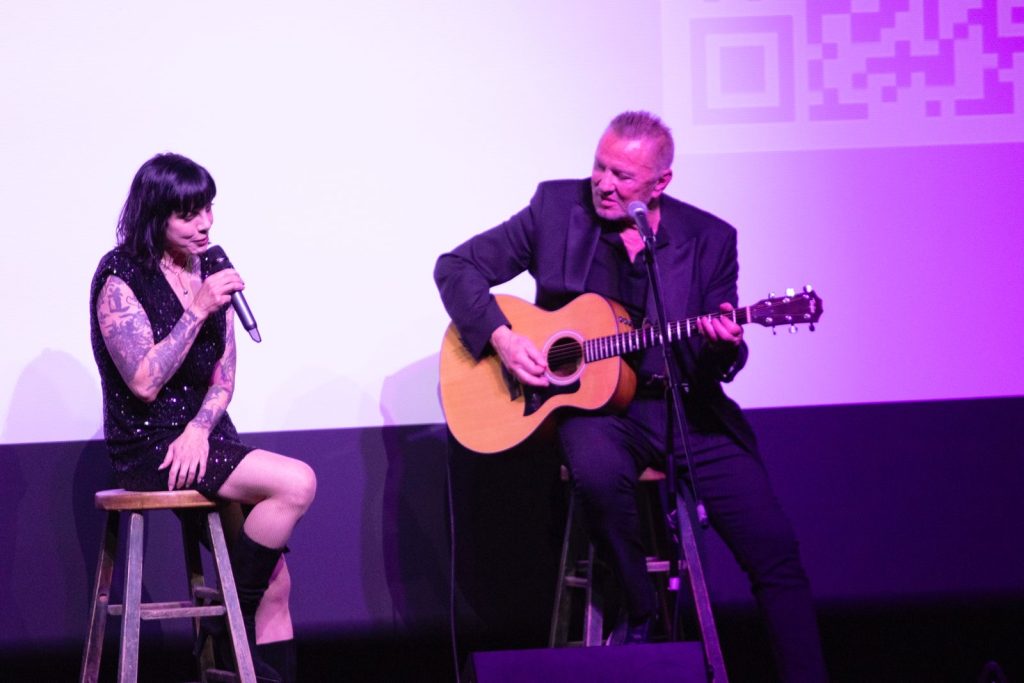
In this interview with Karen Bliss’ Crushing It column for Women in Music Canada, Bif chats
about resilience, being nice, sexism, creating during stressful times, diversifying in the arts,
and so much more.
The documentary shows your resilience and your kindness. What do you think epitomizes
you? What are the traits that have got you this far in the industry?
A lot of people bemoan the people-pleasing quality of our culture. It’s kind of frowned upon;
it’s looked down on. Over the years, I’ve always been one. I blame my parents; I blame my
mother. I can’t help myself; that’s just how I’m built.
I’ve had the same manager for 35 years almost, and he always felt I was ingratiating myself.
Him and [co-manager from 1994-≈2005] Jon Zazula, may he rest in peace, they both always
said, “Just don’t talk, just let us talk, because you are just ingratiating yourself, don’t kiss ass,
you’re being a kiss ass, you’re being a suck up, don’t be a suck, don’t do that, stop doing
that” because on the rock tours, it literally was always men. The crew was made up of men,
the tour managers were men, the other bands we were playing with were men, and I would
be always thanking everyone, going out of my way and they would be like, “Stop that. You
either are being misread as an ass-kisser, or they think you like them. Stay on the bus.” So, I
felt like I was grounded all the time.
Do you agree with that? I always tell young artists being nice goes a long way. Talent
notwithstanding, there’s people in this industry, like Nelly Furtado, Sam Roberts, and guys
in Billy Talent, who are lovely people, so in those early years you wanted to talk to them,
interview them, help them, work with them, give them opportunities. The people that
aren’t, for me, not so much.
100%, I do agree with it, and this is my point. The thing that has allowed me and enabled me to last in the business is the fact that I’m a people pleaser because what it really means is
that you enjoy pleasing people, and there is nothing wrong with that. We have built our
society so it’s so popular to scold people for having that aspect of their personality. I think
that that’s absolutely wrong. Part of my resilience is kill them with kindness, and I think that
that is what has enabled me to last as long as I did.
Believe me, there has been a lot of instances where I have met artists, bands that we’ve
toured with, I’ve never met anyone that I didn’t like, and that is a true statement. I have
hardly ever come across anyone, really and truly in life, that was a complete and total
asshole in the business. I can’t hardly think of anyone that I can sit here and go, that guy or
that lady is a real jerk. If they are, it’s behind your back. And there are notorious jerks, as we
all know, in the business.
Throughout our long careers, especially in the early years, we had to have a thick skin and put up with sexism and creeps. We didn’t have anywhere to turn or movements to encourage us to speak up. What advice can you share with the younger generation in the industry?
Those things, it’s not like they’ve changed; it’s not like they’ve gotten worse because that
has always existed; I think that our ability to deal with it, and move on, that has changed.
When we were young artists, we didn’t know that we could say something and be taken
seriously. So, we thought we had to tolerate it, and live with it, whether it was a guy groping
us, or putting his hand on our back or our butt. We just had to deal with it.
Also, our job was, the show must go on, because, as girls, we were few and far between.
We’re not going to sacrifice our slot in the festival lineup because one of the promoters
copped a feel. Our band’s going to look at us and go, “Take it on the chin. This is our shot.”
So, we would never sacrifice our band. That was our mentality. We would never expect
them to also sacrifice their shot at playing with the Prodigy, in front of 60,000 people, just
because “oh, no, this, this bad man, he might have touched my butt, but I’m not sure.”
When the #MeToo movement started really taking hold, it was confusing because people
look at us like, “Come on, you should speak up, too; you certainly must have had those
experiences,” and you’re like, “Yeah, I guess I did.” “Well, then you should certainly tell on
them now.” “Well, no. I can’t really do that; I wouldn’t do that because I’m not going to
throw my whole band under the bus, too, for not speaking up.” And then people accuse you
of not being a team player with all the girls. And you become torn because you go, “Well, I
didn’t know; it’s a different era.”
There’s a lot of young bands who will leave the stage, if someone yells, “Show us your tits.”
And I sit there going, “Where are you going? Do not leave the stage, ladies, come back
here,” but it’s their prerogative to leave the stage. So, it just depends. And, that resiliency,
it has to be okay for it to be a spectrum and I have to be okay with that and not be judgy
because now I’m an elder [laughs].
You’ve been in a man’s world, especially as a rock singer. You were fortunate to meet
Peter Karroll, your manager for over three decades. Often, when an artist gets dropped or
sales take a dip, you try another manager. But throughout all your ups and downs, you’ve
stayed together. Tell me why.
There’s gotta be a million reasons. And I feel also for him as a manager, because I’ve had
many years where it’s just like, you know, meh. God, we started a label together, for
example. And there was a time where Her Royal Majesty’s Records signed artists. In the 90s,
we had artists like Fresh Bread. And we had artists like Gabezra And…The Way Out, who I
still maintain was the next Simon & Garfunkel. They were so enormously talented. But it was
just so fucking difficult. We had some amazing artists on that label, even The Vincent Black
Shadow, who turned out to be terribly ungracious in the end. And that was just incredible
learning for me. And, going through that with Peter was incredible. And in the documentary,
he touches on the Bodog Music years when we changed Her Royal Majesty’s Records to
Bodog Music. And that was, again, huge learning. We came up with this
Superbeautifulmonster record. That’s my favourite record, but it was really an emotional
time. I got to write with Jimmy Allen from Puddle of Mudd. I got to write with Linda Perry;
we wrote four songs for that record, none of which were on it.
As you mentioned, you ran your own label, Her Royal Majesty’s Records, then you meet
billionaire Calvin Ayre [of online gambling empire Bodog] and launch Bodog Music. Why didn’t it work, or did it and it just ran its course?
It did work. We started the label in ’94, so my first record [self-titled] and I Bificus, were on
Her Royal Majesty’s Records. All we ever did were licenses. So, I Bificus was licensed to Sony
550; was licensed to Lava /Atlantic, licensed to Epic Germany, always licensed. And that was
all Peter. And Peter was producer and he co-wrote. I wouldn’t be standing without Peter’s
belief in me all this time.
And working with Calvin was incredible because for me as an artist, I looked at Calvin also as
an artist and he was a silly, funny artist for me to be around and work with. But really, Peter
was managing Calvin in many ways and got Calvin on the cover of Forbes magazine and had
to spend more and more time devoted to him. It was such a wild ride doing Bodog Fight
before UFC and Peter being Peter put me on as the host of Bodog Fight. And so, in between
the Bif Naked tours, I would fly to interview all these Bodog mixed martial artists all over
America and Europe [chuckles], which was, for me, not healthy because that became my
terrible dating pool. And also, I was touring. And so it was so much, all the time, but it was
amazing.
Then, they had Bodog Battle of the Bands, which was on Fuse in America at the same time.
It was just insane. It was so busy and so insane. It was just the most wild ride. I think that we did, I’m going to say 300 shows a year for a good four or five years straight, and big surprise, then I was diagnosed with breast cancer. I mean, it was nuts. It was so nuts.
In addition to career ups and downs, as an independent artist you’ve gone through a lot
from cancer to divorce. You made an album [2009’s The Promise] when you were going
through chemo. How can someone stay motivated creatively when some days it’s hard to
get out bed, maybe they are dealing with a breakup or death in the family?
Oh, it’s hard. It’s hard to stay motivated. It’s very hard because at the same time, it’s hard to
make a living. It’s very difficult to see the forest for the trees, as they say. It’s never about
the money because when you start as a young artist, even if you don’t go to music school,
even if you’re not in university for fine arts, or even if you’re not in the conservatory of
music, you’re committed to being an artist and you enter in, as a young person, for the love
of performing and somewhere along the line, you lose that perspective. Even if you have
roommates or you have a partner and you start splitting costs and you start being able to
manage a little bit, and you start making a little bit of money or even good money,
somewhere you lose sight of the fact that you’re an artist. And the truth is you have to get
back to centre. And what I mean by that is you have to get back to understanding and
accepting that you’re a working artist and always remember and be happy in the fact that
you are a working artist.
As long as you never forget that and always rejoice in it, you can still coast and be happy in
that because as soon as you forget it, then your shit is going to get fucked up because you
forget your why. And then you get unhappy. You start going, “Oh man, I never get ahead
and I’m never going to move and I can’t go on vacation.” And, you start getting sad and
feeling sorry for yourself. I do. And, if you get any little setbacks, you get overwhelmed in
the things that you don’t have. And also your peers or your sister and her friends or your
cousin or whomever, they’re having kids. They go on cruises with their kids. They’re in their
forties and they are getting ahead and they have a second car or they moved. You’re never
going to have that.
Even divorce, for example. divorce is brutal. My divorce is brutal [chuckles]. My last divorce
was brutal because they will take half. They will 100% take half of your apartment. No
matter what they take half your money, and it costs you legal fees to give them that half.
Just little things like that. And you have to somehow carry on and you have to stay positive
and it can be very difficult to still stay positive. And if you’re not faithy, if you’re not
accustomed to staying positive or have a yoga brain or have little mantras, your shit’s going
to get fucked up. And it’s very difficult to pull yourself out of that rut.
It’s hard to be self-employed. You have diversified in the arts. You’re a musician, you’re an
actor, you’re an author. I’ve had friends between album cycles refuse to get another job
because they are embarrassed, but it’s not failure to branch out. I do bios on the side.
Many artists play corporate gigs. There’s nothing wrong with supplementing your income
by diversifying.
Absolutely. We have to. And I think that comes with age. When we’re younger, we do get
locked into our idea of ourselves or how we self-identify as artists. We have to be flexible, and we have to be willing to branch out and to try other things. And yes, for money, we have to. We are working artists and we have to be willing to work because that enables us to be able to do our art. And so, we have to be able to have a day job, whatever that looks like. Hopefully, it’s still in the performing arts or whatever makes us happy. We have to be able to not be so closed minded, and we have to be able to eat [laughs].
In the documentary, you talk about an album not supported by the label. That’s very
common, putting your heart and soul into writing and recording an album but it not being
promoted or, worse, shelved. It must be so hard to deal with, but you didn’t let that keep
you down.
That is definitely a common story. You just can’t ever give up and that’s the truth. And I
always believe that you just have to keep knocking on the door, no matter what.
And if you have a product — and that’s basically what it is — be willing to go out there and tour it. That’s the difference between rock and pop. Previously, pop artists don’t tour
because they have to have this huge production, generally, but rock artists could play
anywhere. Traditionally, that’s why it always worked; rock artists would play in bars. Now,
it’s different with technology; you could basically go with your iPad and tour anywhere.
Do you advise people to start their own label?
In this day and age, I always say yes because, for example, Taylor Swift had to go and re-
record all her stuff so that she owned it. I was dumbfounded because I’ve always owned my own songs, but I don’t have Taylor Swift money. People aren’t running around downloading my songs [chuckles]. So, from that standpoint, it’s important.
What does it take now to start your own label? Like, nothing. All you have to do is get the
domain, get the Instagram handle, sign them up, do the SOCAN stuff, get them on TuneCore or whatever, and go crazy, Bob’s your uncle. Obviously, I’m not the brains of the organization [laughs], but that’s what I think it entails because now young artists and
budding artists, they’re putting their stuff on TikTok; people are TikTok stars. That’s the
extent of what they’re doing.
You hadn’t put out an original studio album in 15 years until 2024. Is that because you had
gone through cancer, divorce, recorded an album, then took the time to write a memoir,
and creatively you just weren’t feeling it?
Also, because everything changed. There was no platform. Not having a distributor really,
and there was no motivation. There was nothing propelling us to do it. Every summer, I do
the rock festivals in Canada. From time to time, we had a show in Europe and there was just
really no motivation. We made a dance record that had about 30 songs on it.
We never put it out, full stop. We have a million unreleased songs in the queue.
With Champion, we were gonna put it out in 2020, and then the pandemic was underway,
and then we released one song [2020’s “Jim”]. Then a year later, we released another song
and another [2021’s “Broke Into Your Car” and 2022’s “Rollerdome”]. Finally, it came out in
And so, that’s why it took so long. We just did it ourselves and finally put it out. And
then we did the anniversary reissue for I Bificus and then, this year, we’re gonna do
Superbeautifulmonster. So that’ll be fun. And then next year, we’re gonna do the dance
album, which is called The Secret. It’s very fun. I wrote it with Jason Darr years ago from
Neurosonic.
You’re also working on a second memoir. What’s the focus of this one?
Well, the first one I wrote and it ended in 2013 and then it came out in 2016 with
HarperCollins. Jim Gifford was the editor on that; he’s just such a lovely man. But it was a
very sweet and polite little memoir. [Canadian writer] Ivan Coyote told me that the key to
writing a memoir was write it as a fiction. He said that’s the only way you’ll ever be able to
truly write what you want. I was just like, “Oh, never thought about that.” But anyway, it’s
basically an update from 2013 onward.