
photo credit: The Squirt Deluxe
Reader content warning: This article contains sexual language.
“You have to take a risk,” Peaches tells Women in Music Canada’s Crushing It. The Canadian electroclash visionary, who is touring the world behind her latest album, No Lube So Rude, on Kill Rock Stars, has created a sexually progressive, queer-inclusive style and community since the ‘90s, continuing to push the boundaries of music, gender and self-expression as she enters her 60s.
The Torontonian-born Merrill Nisker started her music career in the folk duo Mermaid Café, followed by a one-off solo album, Fancypants Hoodlum, in 1995, before forming an experimental band, The Shit, with some pals in which they all took on pseudonyms. She chose Peaches from Nina Simone’s “Four Women.”
She then taught herself to use drum machines and synthesizers and began performing and developing the Peaches persona — an audacious alter ego that challenged and provoked the music world.
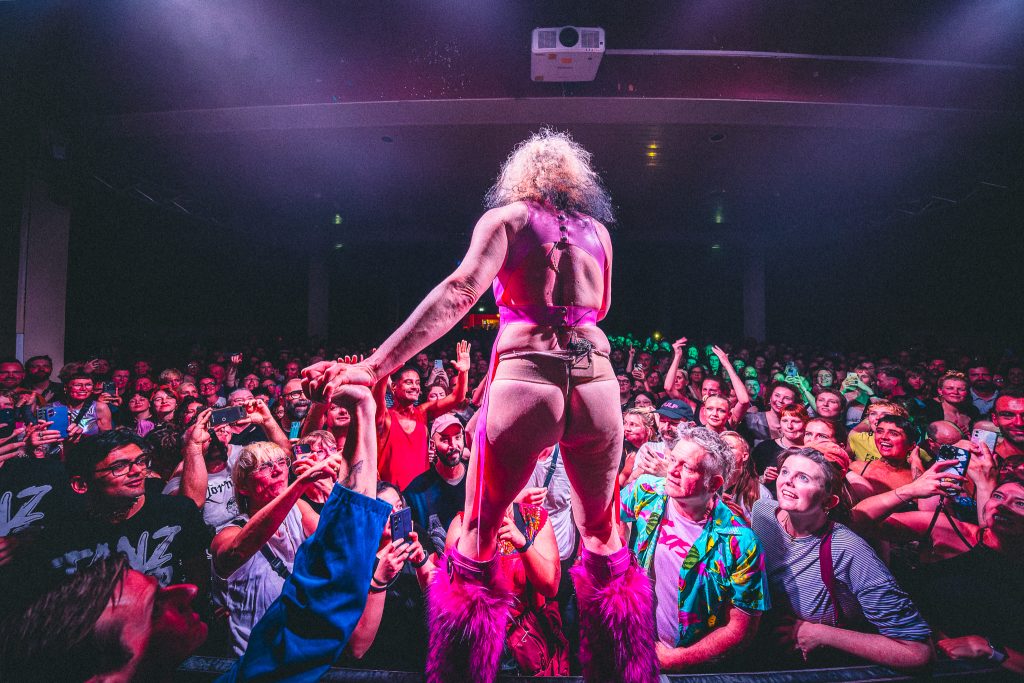
Andreas Budtke – Astra Berlin – @budti
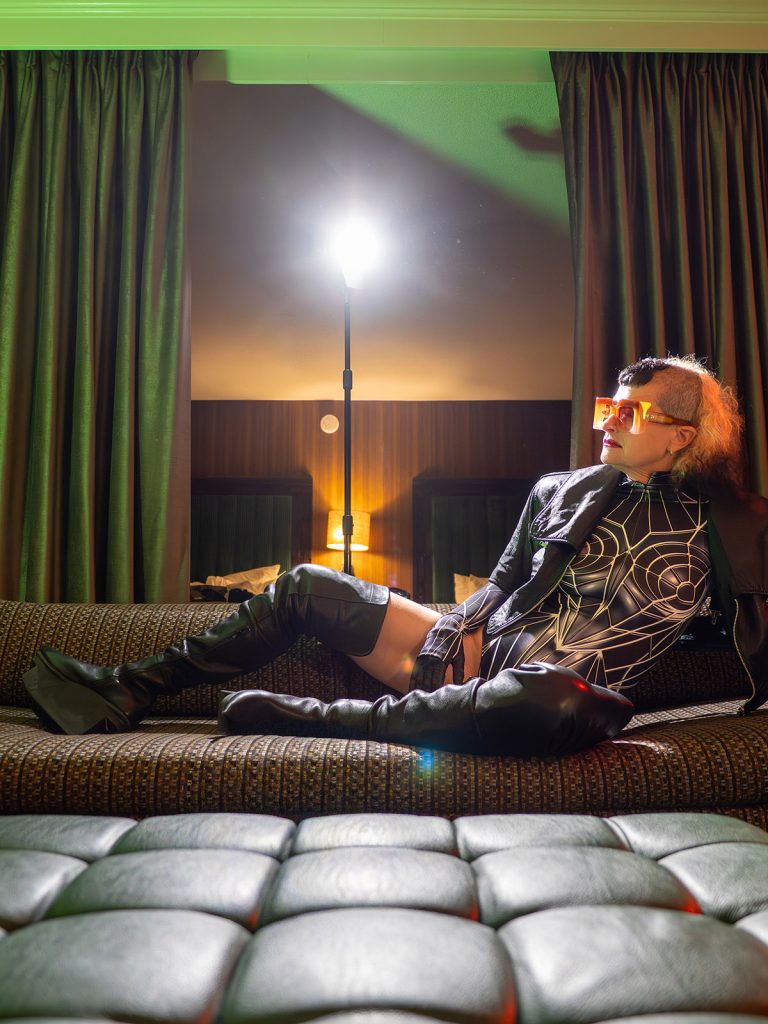
Diverse, provocative, sexy and fun, Peaches has carved a bold explicit path from her lyrics to her stage costumes that’s opened the door for countless others to follow. How did songs called “Diddle My Skittle,” “Fuck The Pain Away,” “Shake Yer Dix,” “Slippery Dicks” and “Tent In Your Pants” become so popular? Through fearless creativity and a refusal to be PG.
Over the past 30 years, she has also recorded or performed with such musically defiant icons as Iggy Pop, Bjork, Madonna and Yoko Ono, and along the way she became an icon too.
She has also diversified into projects that are a natural extension of her recordings and concerts — from Peaches Christ Superstar (a one-woman version of Jesus Christ Superstar) to the electro-rock opera Peaches Does Herself (later a film), to the 1,600 square-foot solo exhibition, Whose Jizz Is This? in Hamburg, and to the 2024 documentary Teaches of Peaches, named after her 2000 debut album as Peaches.
In February, she released No Lube So Rude, her sixth studio album as Peaches, on which she covers everything from politics on “Fuck How You Wanna Fuck” to agism — or what she calls a bragging song — on “Hanging Titties,” with lyrics declaring, “Older than you / Looking so cunt / Oh, look at you /All in my cunt /Thirsty much? My hanging titties / Hit like the punch.”
The ever-creative singer, who has spot dates in Europe and the UK through August, will then begin a North American tour that includes four Canadian dates: Calgary (Sept. 1), Edmonton (Sept. 2), Vancouver (Sept. 4), and Toronto (Sept.26). No Lube So Rude is shortlisted for the coveted Polaris Music Prize but she can’t make the Sept. 22 gala because she’s in Baltimore.
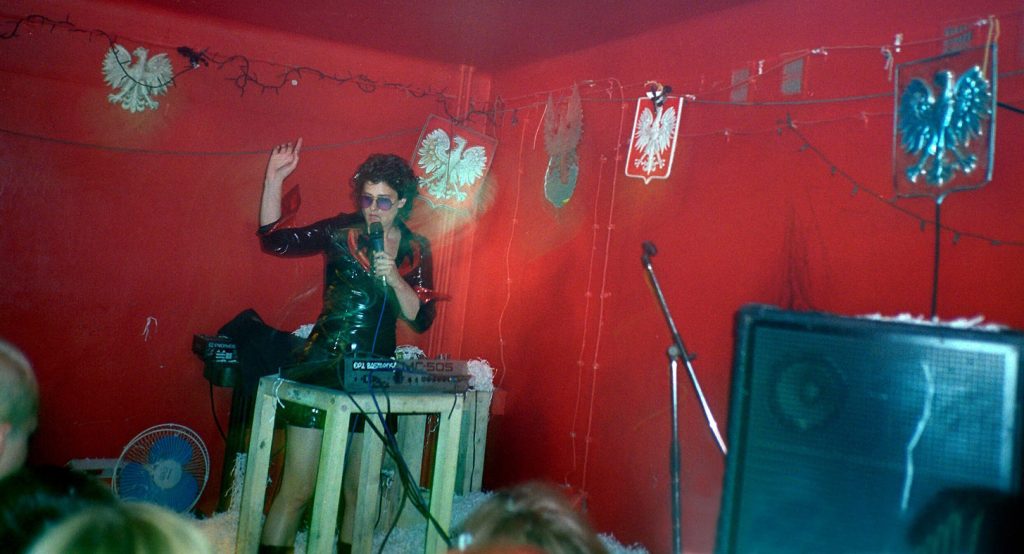
Photo credit: P. Lebruman
In this interview with Karen Bliss for Crushing It, here are the teaches of Peaches for new artists trying to carve out a path.
You are an executive producer on the new documentary, Antidiva: The Carole Pope Confessions. She was singing about queer lust or love in the 80s. What kind of influence did that have on you?
Huge, huge influence. And that she was on mainstream radio [Rough Trade’s “High School Confidential,” “Crimes of Passion”], I wouldn’t have heard it, or it would have taken me longer or Parachute Club’s “Rise Up” and “Mimi on the Beach” by Jane Siberry, just women that cut through in Canada that you were like, “Whoa, this is different. They’re not trying to be like somebody else.” It was a very forgiving time in Canada. They really put those people in the forefront. I feel very lucky that I got to hear that.
What would your family and friends say they noticed about you when you were young that hinted at what you’re doing now?
I was always interested in being creative and I really wasn’t sure what that meant. I didn’t really have a clear vision that I could be a musician. I didn’t understand that that was an option for me, not coming from a musical background and not having any technical musical classes behind me. I definitely wanted to be creative and that’s all I knew.
You had a couple of projects [Mermaid Café and Fancypants Hoodlum] before Peaches. People in the music industry always have opinions, especially for young women on what they should look or sound like. How did you manage to stick to your vision?
People had opinions and none of them stuck with me, what people wanted me to be. I didn’t listen to any of that. I was looking at what was available to me when I was doing Peaches and what I wanted to do and what I didn’t see happening in the world. I just created a world that I wanted because I felt like many things were being left out, a queer vision, an understanding that things didn’t have to be so pure at the time. This was the 2000s. Rock and dance music didn’t need to be separate. We were going beyond “disco sucks” or something like that. All those things that really don’t mean anything that become a standard for no reason. So, I was questioning all the standards and saying, “I’m not buying it” and I also don’t want to be singing along with the lyrics that desecrate me, or lyrics that put me as an object, when I am the person in charge.
We often hear young artists say their second album is really them, the one they wanted to make. How do they resist outside interference?
Do you want this advice? Is it resonating with you? What do you want out of this? Are you interested in just making a lot of money and being famous? Because that is a goal and are you are willing to make certain compromises to get there, like “I will be more like whoever is the person of the moment because I want to make money and sound like the sound now.” If that’s your goal, then that’s how you do it.
If you have a certain vision of how you hear music, if you’re someone like Eartheater, or someone like Bjork, and this is how, hell or high water, you’re going to hear music that way, if someone tells you differently, you’re going to know that that’s not your way. So if it’s music-driven, if it’s more community-driven, if I feel like this group of marginalized people don’t get the attention, and I feel that’s dear to me and I want to, you know, express my politics, it depends what you want out of it, and that you’re going to be happy with how you’re perceived because that’s how you want it.
Do you find that it might be a longer route, but it does work out in the end?
It’s hard to say whether it’ll work out in the end, but you have to take a risk. You have to take a risk. The so-called industry is changing and becoming even non-existent, sort of “What is it really?” It’s just very hard to navigate right now on who to align yourself with, and even certain platforms you might not agree with how they treat artists, but it’s the only way to get your music out there. Sometimes the power that you have, you can only wield that power if you have some sort of success, otherwise you can disappear. So, you, at least, sometimes, have to be savvy about it. It’s tough. It sounds dismal, but I know that there are women musicians who have visions that have never come out. You really have to put in that risk and know that your vision is your vision, and, at some point, it will be seen, if you are really focused on it and you know that you feel what you’re doing.
Is that why you moved to Berlin, however many years ago because Canada just wouldn’t accept your vision?
Yeah. Well, it was a time when there was no real internet presence. It’s a different global market and a different global understanding of music and how we hear music since then. people just didn’t understand that that was a thing, or that it would become a thing, or just didn’t make sense in Canada.
You built a community with other artists, who all had a unique vision for themselves. You helped each other: Jason Beck [Chilly Gonzales] and [Leslie] Feist.
Yeah. And Mocky [Dominic Saoloe]. it wasn’t even like we were all making the same kind of music, but we all had our vision of what we wanted to do. So, in that way, we built a community of just supporting each other, even if it wasn’t our exact music for each of us, but more as a community of friends.
Do you think that could happen now, artists banding together to help advance each other’s careers?
Community is so important. Also, meeting up in live context with each other and sharing ideas. Yeah, it’s always good groundwork. And, also depends on if you want to make online communities. There are so many ways. I wish I had answers, but I’m not a young person. I really am not a young person. It’s really tough out there.
In the 10 years since your last album [2015’s Rub], so much has happened: the #MeToo movement, the overturning of Roe v. Wade, attacks on transgender rights…
So, you’re just saying white supremacy is taking over. Fascism is on the rise.
It feels like there are two different realities: on one hand, there’s greater acceptance and visibility for the LGBTQ community in many places; on the other, there’s what’s happening in America, where many rights are being denied or challenged.
It’s not even just in America. People are just trying to hold on to those systematic ideas, where it’s getting harder and harder for them to hold on to it so they have to create more fear. That’s why we have to keep fighting. It’s wild to think that it’s not just Roe v. Wade overturned, but our whole world has been overturned. But, also, we hear and see things more than we could before because of the internet. And so, all these things were always going on in the background. It’s just that now we can’t unsee it and unhear it because it happens right there. We have to be more aware. It’s not a bad idea for us to be more resilient and more upfront with what we’re doing because otherwise it can just fade.
I remember, people started complaining about Pride, how the banks are pride for the month, everybody is on the bandwagon, and it wasn’t about a struggle anymore; it was just about rainbow flags. It turned into more of a branding thing for companies. And then, maybe it was two years ago, when you scrolled through Instagram during Pride, all of it was fierce, awesome drag queens and queer performers just giving speeches. It became more of a political battle and it’s awakened awareness and awakened art in that way too. So, it’s not all bad.